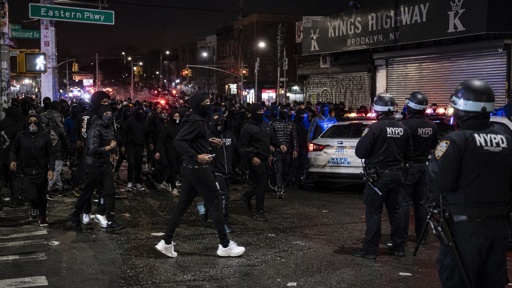
Brooklyn’s Orthodox Jewish neighborhoods faced coordinated intimidation on the night of May 11-12 when masked protesters marching under Hezbollah flags descended on synagogues, targeting families and children in what community leaders describe as an escalation of post-October 7 antisemitic violence.
A Pattern of Escalating Intimidation
The May 11-12 march represents the second coordinated assault on New York City synagogues within six days. Last week, pro-Palestinian demonstrators affiliated with the Palestinian Assembly for Liberation surrounded Park East Synagogue in Manhattan during an Israeli real estate expo, with participants openly voicing support for terrorism and antisemitic violence. The recurring nature of these events, combined with the explicit display of Hezbollah symbols and organized nature of the Brooklyn march, suggests deliberate strategy rather than spontaneous protest.
What distinguishes these incidents from typical political demonstrations is the direct targeting of civilians in residential neighborhoods. Protesters did not gather at City Hall or march through commercial districts. Instead, they moved through Orthodox Jewish enclaves where families live, shop, and worship, creating an environment of fear among residents who describe being trapped between their homes and hostile crowds.
The Response and Its Limitations
The NYPD’s deployment of 400 officers outside the synagogue demonstrates the scale of the threat authorities recognized. However, the absence of mass arrests despite reported assaults on Jewish children and harassment of residents raises questions about enforcement consistency. Officers contained the demonstration but did not disperse it, a restraint that some community advocates argue signals weakness to those intent on intimidation.
Eyewitness accounts from residents and community observers circulated rapidly on social media on May 12, with videos showing masked protesters chanting and confronting police. The documentation occurred in real-time, creating a public record that contrasts sharply with any official narrative that downplays the severity or organized nature of the events.
Political Accountability and Policy Reversals
Mayor Zohran Mamdani’s election in 2025 marked a significant shift in municipal policy toward antisemitism. Where his predecessor Eric Adams implemented strengthened protections and enforcement, Mamdani reversed course, including vetoing a bipartisan bill designed to address rising hate crimes. Critics point to his attendance at pro-Hamas rallies in October 2023, before his mayoral election, as evidence of ideological alignment rather than neutral governance.
The timing matters. A New York Times column by Nicholas Kristof circulated in May 2026 with disputed claims about Israel-Palestine issues. Protesters reportedly cited this mainstream coverage as justification for their march, suggesting that media framing can either elevate or diminish the perceived legitimacy of such actions. When influential outlets present contested narratives as settled fact, they risk providing rhetorical ammunition to those seeking to mobilize street action.
The Broader Context of Post-October 7 Antisemitism
Since October 7, 2023, when Hamas killed approximately 1,200 Israelis in the deadliest attack on Jewish people since the Holocaust, New York City antisemitic incidents surged more than 300 percent according to Anti-Defamation League data. Brooklyn’s Orthodox neighborhoods—including Borough Park and Williamsburg—have become focal points for repeated targeting. Campus occupations that began as Gaza advocacy evolved into street-level harassment campaigns targeting Jewish residents.
The distinction between criticism of Israeli policy and antisemitic violence matters profoundly. Protesters displaying Hezbollah flags are not engaging in political speech about Middle East policy; they are displaying support for a designated terrorist organization. Chanting “Allahu Akbar” while surrounding synagogues crosses from protest into intimidation tactics designed to terrorize a specific religious group in their own neighborhoods.
Antisemitic Mobs Invaded Jewish Neighborhoods in NYC Again Last Night https://t.co/A5vVvZz4bV
— Yvette B Colon (@col78086) May 12, 2026
What Comes Next
Community leaders and observers now face a critical question about municipal governance. If antisemitic mobs can march through residential neighborhoods targeting families with minimal consequences, what incentive exists for restraint? The absence of accountability creates conditions for escalation. History demonstrates that when local authorities fail to enforce equal protection, organized groups become emboldened.
The May 11-12 incident in Brooklyn represents more than a single night of harassment. It reflects a governance vacuum where ideological sympathy for anti-Israel causes appears to override the fundamental municipal obligation to protect all residents equally. Jewish New Yorkers now confront the reality that their safety depends not merely on police presence during crisis moments, but on elected officials who prioritize their protection consistently and unambiguously.
Sources:
Antisemitic Mobs Invaded Jewish Neighborhoods in NYC Again Last Night
Antisemitic Mobs Invaded Jewish Neighborhoods in NYC Again Last Night