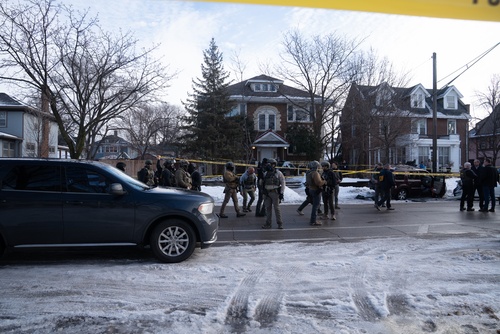
A quiet Iowa river town is reeling after police say a 52-year-old man gunned down six family members in a suspected domestic dispute before turning the gun on himself.
Story Snapshot
- Police in Muscatine, Iowa say six people were killed at multiple locations before the suspected gunman died by suicide.
- Authorities believe every victim was a relative of the suspected shooter, 52-year-old Ryan Willis McFarland.
- Investigators say early evidence points to a “domestic dispute,” raising new questions about family breakdown and warning signs.
- The case highlights ongoing concerns about public safety, mental health, and how authorities communicate in the first hours after a mass killing.
Police Outline a Family Mass Killing in Muscatine
Muscatine, Iowa police say a “series of homicides” unfolded across two homes and a business, leaving six people dead before the suspect, identified as 52-year-old Ryan Willis McFarland, took his own life. Officers responding to calls on a Monday discovered victims at separate locations, then quickly connected the scenes as part of a single, coordinated attack. Authorities later told reporters that McFarland was believed to have killed his relatives before dying of an apparent self-inflicted gunshot.
UPDATE: 7 people dead after murder-suicide in Muscatine; school district responds https://t.co/miuxwEoGgx
— 8News WRIC Richmond (@8NEWS) June 2, 2026
According to briefings reported by local and national outlets, investigators said early evidence suggested the shootings arose from a domestic dispute inside the extended McFarland family. Police emphasized that, at this stage, there was no indication of a random attack on the public or any broader threat to the community. All of the dead, authorities said, were believed to be family members of the deceased suspect, a fact that turned this from a generalized crime story into a concentrated family tragedy.
Domestic Dispute Label Raises Hard Questions
Law enforcement officials often rely on a “domestic dispute” label in the first hours after a family mass killing, because the victims and suspect are closely related and early evidence points to internal conflict. In this Muscatine case, that framing appeared almost immediately, with police publicly stating that a domestic dispute likely triggered the violence. Yet investigators have not released a detailed motive, leaving the public with a broad term that can cover anything from longstanding abuse to financial strain or bitter separation.
Researchers who study family and intimate-partner homicides note that many such cases are preceded by warning signs, including control, emotional or physical abuse, or access-to-weapon issues that rarely surface in first-day news coverage. The Muscatine killings fit a pattern in which an alleged perpetrator dies, leaving no trial and very limited opportunity to test assumptions about motive in court. For families, neighbors, and church communities, that means some of the “why” behind this violence may never be fully documented, even as the domestic-dispute explanation hardens into accepted fact.
Community Grief, Media Framing, and Public-Safety Concerns
Residents of Muscatine are left grieving multiple generations lost in a single day, while schools and local institutions scramble to offer counseling and support. Local coverage emphasized that students and staff connected to the victims would receive mental-health resources, reflecting how deeply a family massacre can ripple through a small city. For many Midwestern families who prize stability, faith, and close-knit neighborhoods, this kind of violence feels like an assault on the very idea of home as a safe place.
National outlets quickly spotlighted the role of a domestic dispute, the family relationship between the suspect and victims, and the rapid police response. What remains less developed in early coverage are the deeper questions about how authorities track family risk, communicate threats, and support those who see trouble brewing but feel powerless to intervene. As investigators work through autopsies, digital records, and family histories, the public will be watching to see whether this case becomes another brief headline or a catalyst for honest conversation about family violence, mental health, and early warning signs.
Sources:
[1] Web – Police investigate Iowa man suspected of killing six of his relatives …
[2] YouTube – Police investigate Iowa man suspected of shooting 6 of his relatives …
[3] Web – In the US, a gunman killed six family members and himself | УНН
[4] YouTube – 7 dead, including shooter, following shootings in Muscatine
[5] YouTube – Six Family Members Killed In Iowa, Gunman Then Takes Own Life
[6] Web – Police investigate Iowa man suspected of killing 6 of his relatives …
[7] Web – Shooting in Iowa: six dead in Muscatine – Demócrata
[8] YouTube – Iowa shooting spree: 6 killed in domestic dispute, suspect also dead
[9] Web – 6 killed in Iowa shooting spree in domestic dispute, police say
[10] Web – 6 killed in Iowa shooting spree in domestic dispute, police say
[11] YouTube – Gunman kills six family members, then himself, in eastern Iowa …