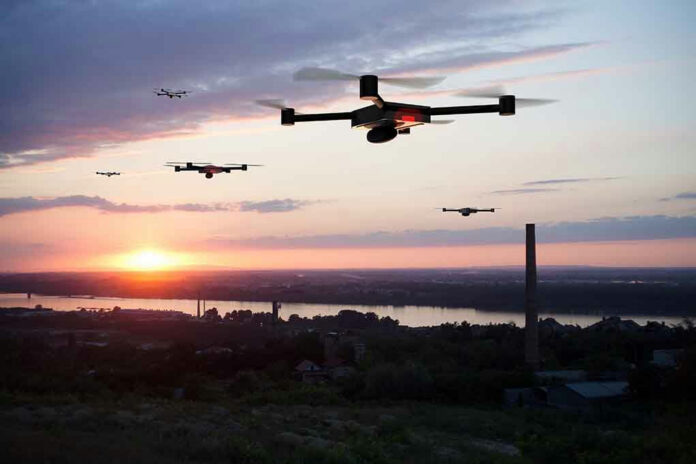
A drone scare that sent Lithuania’s president and prime minister rushing to bunkers is the latest reminder that unsecured borders and weak air defenses in Europe can drag Americans into danger and distraction abroad.
Story Snapshot
- Lithuania ordered residents, schoolchildren, and top leaders into shelters after a suspected drone violated its airspace.
- Vilnius Airport and rail traffic were halted while North Atlantic Treaty Organization (NATO) fighter jets scrambled to respond.
- The incident, likely tied to the ongoing war in Ukraine, shows how tense and fragile the security picture is along NATO’s eastern flank.
- Unclear facts about the drone’s origin and intent highlight how modern crises can be real, yet also shaped by politics and media spin.
Leaders in Bunkers as Lithuanians Get ‘Seek Shelter Now’ Alert
Residents in Lithuania’s capital, Vilnius, saw their phones light up with an air-raid style notice shortly after 10 a.m., warning them to “go immediately to a safe place,” as authorities reported a suspected drone entering the country’s airspace.[1][2] Schools rushed children into basements, traffic slowed, and everyday life froze. Reports say President Gitanas Nausėda and Prime Minister Inga Ruginienė were escorted to underground shelters, underscoring that this was treated as a genuine security emergency, not a drill.[1][3][4]
For roughly an hour, air traffic at Vilnius Airport was suspended and trains around the capital were halted while defense officials assessed the threat.[1][2] NATO Baltic air policing assets were activated, with fighter jets scrambled in an effort to locate and, if needed, neutralize the object.[1][2] Lithuania’s crisis managers publicly framed the incident as involving “what was likely a drone,” possibly linked to the broader war raging in nearby Ukraine, placing this scare inside a wider pattern of regional tensions.[1]
🇱🇹🤡"Lithuanian leaders take shelter in a basement during an air alert": NATO aircraft failed to shoot down a Ukrainian drone.
"The President and Prime Minister of Lithuania were forced to take shelter in bunkers when an announced air alert paralyzed Vilnius. Flights, road and… pic.twitter.com/OtTrjvlHMy
— Beate Landefeld (@BeateLandefeld) May 20, 2026
Drone Threats on NATO’s Eastern Flank and What We Actually Know
Broadcast reporting and European coverage describe a suspected drone approaching from the direction of Belarus, near Lithuania’s border, prompting an immediate defensive response from Lithuanian authorities and NATO.[2] Officials have not, however, released radar plots, debris photos, or a detailed incident report that would confirm the craft’s exact model, payload, or intent.[1][2] One crisis official later said fighter jets were scrambled, but that the drone either crashed or left Lithuanian airspace before interception, leaving key technical questions unresolved.[1]
This ambiguity does not mean the alert was fake; it means citizens are again asked to trust government statements without seeing the underlying data. Earlier in the week, NATO aircraft reportedly shot down a drone over neighboring Estonia, which Tallinn initially said entered from Russia but was later described as a stray Ukrainian drone.[1] That confusion shows how quickly early attributions in this crowded airspace can change. For conservatives used to questioning official narratives, it is a reminder to separate real threats from rushed political storytelling.[1]
Why This Matters to American Conservatives Watching from Home
The Lithuania scare is part of a broader trend since Russia’s expanded invasion of Ukraine in 2022, where unidentified drones and ambiguous radar contacts trigger immediate defensive measures, then only later receive fuller explanation.[1][2] NATO has deliberately chosen a posture along its eastern flank that favors rapid reaction, even at the risk of false alarms, because the cost of hesitation could be far worse if a hostile missile or armed drone were actually inbound.[1] That logic is understandable, but it also gives political leaders enormous power over how “threats” are framed to the public.
Lithuanian leaders rushed to bunkers as drone violates country’s airspace
Vilnius residents urged to take shelter during alert, after Nato and EU warn that Russia is divertin… Read more: pic.twitter.com/2DBy0Ex8Mu
— Raw feed news (@Rawfeednews) May 20, 2026
For American readers who value strong borders, limited foreign entanglements, and clear evidence before escalation, this episode is a double-edged signal. On one hand, it shows why serious nations invest in air defense, early warning systems, and hardened leadership shelters instead of pouring money into climate slogans and woke bureaucracy. On the other hand, it exposes how quickly a single drone report can shut down an entire capital, move presidents into bunkers, and fuel talk of broader confrontation without a publicly verified understanding of what actually entered the sky.[1][2]
Sources:
[1] YouTube – Lithuanians scramble to take cover over drone alert
[2] YouTube – Lithuanians briefly head to bunkers following drone alert
[3] Web – President bundled into bunker as drone shuts down …
[4] YouTube – Residents and leaders take shelter during drone alert